

They’re probably featured in your children’s favorite history books and appear in some of the most iconic film franchises. Pirates – and the entire culture of piracy – hold a special place in our imagination when it comes to the seas and tales of adventure. But did you know that beyond their status as pop culture legends, pirates are also a fascinating subject for historians? That’s precisely the case for Denver Brunsman, who devotes part of his research to understanding how piracy connects with the historical processes of maritime expansion, state control, and resistance.
Brunsman specializes in the history of the American Revolution, the early republic, and the British Atlantic world. In The Evil Necessity, he examines forced naval enlistment in the British Navy as both a political and social issue in the eighteenth century.
He has also edited volumes and published numerous articles on the construction of political identity in the United States and Britain during this period. Renowned for his teaching excellence, Brunsman has received the Trachtenberg Prize for Teaching and teaches popular courses on U.S. history, including one dedicated to the life of George Washington, which he delivers each year at Washington’s historic home in Mount Vernon.
In this interview, two Brazilian scholars who worked with Brunsman at GWU – Daniel Gomes de Carvalho (USP) and Marcos Sorrilha (Unesp) –discuss the American Revolution, George Washington, and the history of piracy. Read on to see how the conversation unfolded.
Why can piracy be understood as a form of resistance against the growing control of states over maritime trade and labor?
In the early modern era, as European states formed and expanded, they attempted to consolidate their power both on land and at sea. A critical part of this process was establishing control over trade and commerce. States accomplished control through various regulations (for example, the Navigation Acts in England) and by asserting a monopoly over violence. In other words, no longer would vigilante armies go unchallenged on land, nor would the equivalent – piracy – be allowed to continue at sea.
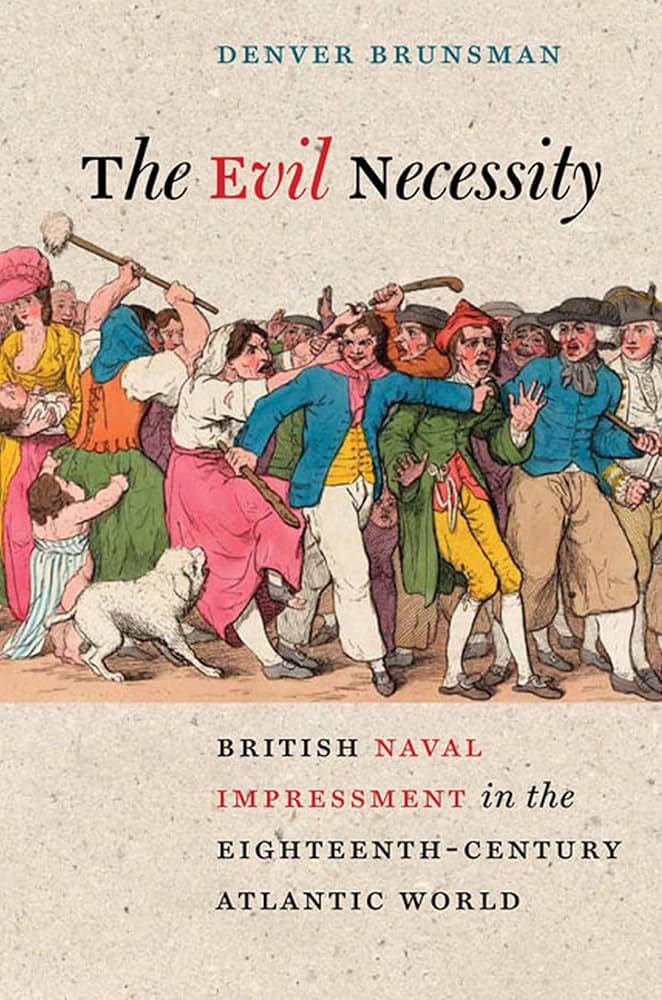
The Evil Necessity: British Naval Impressment in the Eighteenth-Century Atlantic World, By Denver Brunsman.
Considered in this light, piracy absolutely signified a form of resistance against state control. Here we have to distinguish between pirates and privateers. Privateers can be thought of as mercenaries who operated with state sanction to advance official state interests; they carried letters of marque to signify state approval. But pirates who worked without state sanction were just that – pirates – and they came to threaten state interests, especially by the late seventeenth and early eighteenth centuries.
How did pirates challenge imperial powers in the 18th and 19th centuries?
As European states became imperial powers, they depended more and more on overseas commerce to fill their treasuries. In this situation, pirates could wreak havoc on different empires, whether they operated in the Caribbean, Mediterranean, or Atlantic and Indian Oceans. By the eighteenth century, the British Empire became particularly dependent on trade and likewise faced the greatest threats from pirates. In the Caribbean, this situation led to an intense period of war on piracy from roughly 1716 to 1726.
Notably, this time of war on pirates was generally a period of peace among European imperial powers. Piracy always expanded in times of peace because many mariners turned to piracy after serving in naval vessels that decommissioned after wars. In this way, there was an internal logic to piracy – it gained a predictive quality in the cycle of early modern wars. But, for the same reason, European powers, especially the British, could not allow piracy to persist. States did not war against one another to then lose their overseas riches to non-state actors, or pirates. After 1726, pirates continued to prey on European trade, but they were much diminished and no longer rivaled the power of state navies at sea.
Do you see connections between Atlantic piracy and the revolutionary movements of the late 18th and early 19th centuries, such as the American Revolution, the French Revolution, and Latin American independence struggles?
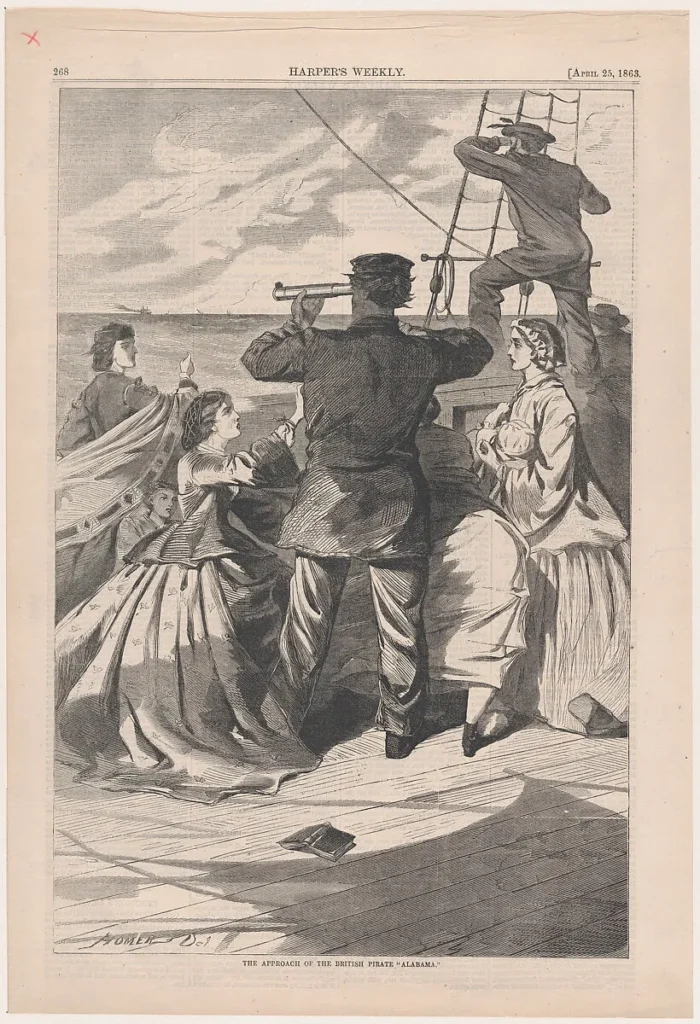
The connection between Atlantic piracy and the Age of Atlantic Revolutions is a fascinating topic. I believe much more work could be done to explore various connections – from individuals to ideas – shared between piracy and revolution. I am most familiar with the American Revolution. The British often condemned the rebelling American colonists as “pirates.” The label had some truth since the colonists could not manage to create a proper European-style navy in time for the American Revolutionary War. Instead, they depended heavily on privateers and naval officers, like John Paul Jones, who raided British shipping and seaports like the pirates of old.
Significantly, the conflicts at sea during the various Atlantic Revolutions were much less regulated than fighting on land. In directing land forces, leaders such as George Washington, Toussaint Louverture, and Simón Bolívar all worried to varying extents about establishing the legitimacy of their respective causes and new states. In the eighteenth and early nineteenth centuries, such legitimacy came in large part by forming European-style armies and following accepted rules of war. This was much less the case at sea, where colonial forces were much weaker and hence resorted to whatever tactics they could. At sea, both European powers and insurgent colonial forces engaged in much more indiscriminate captive-taking and impressing (forcing people into service). These tactics had long been considered acts of piracy in the European tradition.

How did the experiences of American sailors and pirates – many of whom were forcibly enlisted into the Royal Navy – contribute to the development of a distinct colonial identity? Did this process help strengthen the anti-British sentiment that ultimately led to the American Revolution?
The British Empire fueled its rise in the seventeenth and eighteenth centuries through forced labor, most notably slavery, but also through British naval impressment, or forced service, at sea. Impressment affected colonial mariners before the American Revolution. The practice was never popular and caused some of the largest disturbances against British imperial rule before the Stamp Act Crisis of the mid-1760s. Scholars of the American Revolution are generally very careful not to assign any single British policy or action as the main reason for independence. It was the accumulation of different British acts in the 1760s and 1770s, which together threatened American sovereignty and led to war, that caused American independence. In this regard, American Revolution scholars are quite different from historians of the American Civil War (1861-1865), for which there is scholarly consensus that the war had a single cause: slavery.
With that caveat, I do think that impressment helped to politicize and radicalize American seaports in the 1760s and 1770s. Sailors who faced the risk of being captured by British naval press gangs became some of the most consistent anti-British rioters. Ultimately, impressment became a symbol of British tyranny. It is even listed as the 26th (of 27) grievances against King George III in the Declaration of Independence: “He has constrained our fellow Citizens taken Captive on the high Seas to bear Arms against their Country, to become the executioners of their friends and Brethren, or to fall themselves by their Hands.” Some American revolutionary pamphlets and newspapers even referred to the British as the “pirates” or “marauders.” This was a clever way for the Americans to capture the rhetorical high ground even when they were the actual pirates by engaging in more piratical acts at sea than the British.
Some historians, such as Antoine Lilti, have reinterpreted the figure of George Washington, analyzing him not only as a leader devoted to the common good but also as an 18th-century celebrity. What are the latest developments in the historiography of Washington? Why is it still worthwhile to study him today?
Ever since his death in 1799, George Washington has been the most popular subject of American biographers. Over time, the vast majority of this research and writing has been done by non-academic historians. Today the most significant trend in the historiography is an explosion of works on Washington by academic historians. This growth in Washington studies roughly coincides with the opening of the George Washington Presidential Library at Mount Vernon in 2013. Since then, the library has supported academic research on Washington and the founding era. In addition, scholarly interest in slavery has naturally extended to Washington since Mount Vernon has among the best-preserved records of any colonial or early national plantation. Some of the leading works on Washington and slavery include Erica Armstrong Dunbar, Never Caught: The Washingtons’ Relentless Pursuit of Their Runaway Slave, Ona Judge (2017); Mary Thompson, “The Only Unavoidable Subject of Regret”: George Washington, Slavery, and the Enslaved Community at Mount Vernon (2019); and Bruce A. Ragsdale, Washington at the Plow: The Founding Farmer and the Question of Slavery (2021).
As scholars have become more open to studying Washington, they have discovered that he can contribute to a number of other important topics, including Indigenous societies in the American founding period (Colin G. Calloway, The Indian World of George Washington: The First President, the First Americans, and the Birth of the Nation, 2018); gender and masculinity (Maurizio Valsania, First Among Men: George Washington and the Myth of American Masculinity, 2022); and women in the eighteenth century (Charlene M. Boyer Lewis and George W. Boudreau, eds., Women in George Washington’s World, 2022). Antoine Lilti’s work on the invention of celebrity in the early modern period is certainly part of this trend. Put simply, Washington had so much influence and left so many records that he can provide a useful perspective for a variety of issues in the eighteenth century.
Along with all these other topics, we cannot overlook the creation of the United States. For as long as the United States remains an influential nation, I believe there will be interest in studying George Washington. The reason is that Americans still live in the society and with the frame of government created during the American revolutionary era, when Washington was the most significant figure. Therefore, in a very real sense, to know Washington is to know America. Both Washington and the United States have enough admirable, regrettable, and contradictory qualities to keep scholars busy for a very long time.
Daniel Carvalho is a professor of Early Modern History at the University of São Paulo (USP) and editor of the História Pirata podcast. Marcos Sorrilha is an assistant professor at the São Paulo State University (UNESP) and the creator of the Canal do Sorrilha on YouTube.
How to cite this Interview
BRUNSMAN, Denver. “I believe much more work could be done to explore various connections shared between piracy and revolution”. Interview by Daniel Carvalho and Marcos Sorrilha. Translation: Bruno Leal. In: Café História. Published on July 7, 2025. Available at: https://www.cafehistoria.com.br/piracy and revolution/. ISSN: 2674-5917.